Latest updates

STILS will provide ongoing updates and news regarding the development of the project. See below for our most recent updates.
2026
Trauma-informed lawyering is an approach to legal practice that recognises that many people who interact with legal systems have experienced trauma, and that these experiences can shape how they communicate, make decisions and engage with legal processes. Rather than focusing only on the legal problem, trauma-informed lawyering asks lawyers to consider what may have happened to a client and how that experience might affect their interaction with the law. It involves adapting legal practice to promote safety, trust, clear communication and meaningful participation in legal processes.
In practice, trauma-informed lawyering emphasises respectful relationships between lawyers and clients. Lawyers seek to create environments where clients feel psychologically safe, understand the legal process, and have genuine choice and control over decisions affecting their case. This may involve explaining legal procedures clearly, avoiding practices that may retraumatise clients, supporting clients to tell their story in their own way, and recognising how trauma can affect memory, communication and behaviour.
Many people who rely on legal assistance services have experienced violence, discrimination, poverty or other forms of adversity. These experiences can make legal processes confusing, intimidating or distressing, which may prevent people from seeking help or participating effectively in their own cases. By responding to these realities, trauma-informed approaches can improve communication, strengthen trust between lawyers and clients, and support people to engage more confidently with the legal system.
Trauma-informed approached also aim to reduce the risk that legal processes themselves cause further harm. Traditional legal procedures can unintentionally retraumatise people, particularly when they are required to repeatedly recount distressing events or navigate unfamiliar and adversarial settings. Trauma-informed lawyering seeks to minimise these risks while maintaining strong legal advocacy, helping legal services deliver fairer and more accessible justice.
Despite growing interest, the evidence base for trauma-informed lawyering is still developing. Much of the existing literature identifies strong theoretical reasons to adopt trauma-informed approaches, but there remains a need for empirical research evaluating how these practices affect client experiences, legal outcomes and workforce wellbeing. STILS aims to address this gap by testing and evaluating trauma-informed practices within real legal service settings.
This is the first in a series of ongoing updates regarding the progress and development of the STILS project.
STILS officially commenced implementation in late 2025 and continues to make significant progress.
The STILS team has assembled our Advisory Group that will provide lived-experience expertise and direction for the project. This group is to be chaired by Lived Experience Lead Bowzer Scharka.
Pre-implementation focus groups and interviews were completed through October 2025 at all Phase A sites (Melbourne migration team, Wollongong family law team and Alice Springs criminal law team).
This was followed by the delivery of an initial trauma-informed lawyering training from With You, as a part of National Legal Aid. You can read more about the work of With You here.
Follow-up mid-implementation focus groups and interviews have subsequently been conducted at all Phase A sites, with the project now moving towards qualitative data gathering from legal aid clients as well as end-implementation stage focus groups and interviews.
All Phase A teams have also benefitted from toolkit items specific to the needs of respective teams, such as specific and additional trainings, targeted brokerage, resource development support, and enhancement to physical office spaces, amongst others.
STILS has initiated engagement with all Phase B sites, with pre-implementation data gathering and delivery of the With You training to occur from April 2026.
Update
The STILS project has made significant progress through the first half of 2026, with implementation across all sites now either completed or underway. This is an important milestone given the scale of the project, with research sites across Australia including regional and remote locations. As the first study of its kind to examine the impact of trauma-informed lawyering on clients experiencing marginalisation, STILS is capturing critical evidence to inform future legal practice and improve client outcomes across the sector.
The With You training has been delivered to all sites, alongside coaching for managers and group supervision sessions for legal teams. The With You Trauma Informed Organisational Toolkit (‘the Toolkit’) continues to be implemented to improve client experience of criminal, family and civil law practices. Some examples of these initiatives are training tailored to the specific local context, improving physical space, ensuring information provided to client are accessible, and brokerage funds
We extend our sincere thanks to our partners at Legal Aid NSW, Victoria Legal Aid and Legal Aid NT for their collaborative approach and commitment to the project. These partnerships have enabled the research approach to be responsive to local service contexts and client needs, ultimately ensuring that final findings will be grounded in the reality of legal practice.
Darwin trip
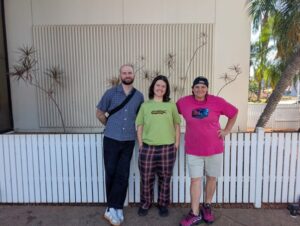
The STILS team recently travelled to Darwin to interview staff, clients and other stakeholders. The STILS team is grateful for the significant support given to the project by Jane Irwin – Associate Director of criminal law at Legal Aid NT – and by her team, who were instrumental in linking the STILS team in with client participants. The STILS team is grateful for the support and cultural guidance of Rocket Bretherton, NT Coordinator of the Justice Reform Initiative.
The STILS team spent three days at the busy NT Local Court interviewing clients about their experiences with the Darwin criminal law team. These interviews gave the team valuable observations of the pressures faced by both clients and lawyers. Due to current funding issues, there has been a significant reduction in available legal representation, increasing stress for both clients and lawyers. Clients expressed concern at the prospect of potentially appearing unrepresented as a result of these issues.
During our time in Darwin, the STILS team was fortunate to be given a Saltwater Welcome to Country onto Larrakia land, by James Parfitt and Richie Fejo Jr. James is a Larrakia man, traditional owner, and Community Legal Educator for the North Australian Aboriginal Justice Agency (NAAJA). The project is working closely with James who, along with his colleague John Rawnsley, will be facilitating the delivery of cultural training to the Darwin Legal Aid criminal law team in September. The team is grateful to James and Richie Jr for their Welcome and hospitality while in Darwin.
Phase A
Data collection and toolkit implementation for Phase A sites have now largely concluded.
Phase B – currently ongoing
Phase B sites are the Victoria Legal Aid migration team in Melbourne, the Legal Aid NSW family law team in Gosford and the Legal Aid NT criminal law team in Darwin. Initial focus groups and interviews have been completed across all sites, with mid and final-focus groups and interviews variously completed or scheduled. Client interviews remain ongoing or planned across all sites.
Toolkit implementation has been positively engaged with by all Phase B sites, delivering significant physical space improvements, cultural trainings, client resources and brokerage funds, among others.
What’s next?
Interim findings are expected following the conclusion of both Phase A and Phase B in mid-2027. Final findings will be released at the conclusion of the project in 2028. We anticipate this research will provide important insights about trauma-informed practice for clients, practitioners and organisations, including in relation to client experience, staff wellbeing and workforce sustainability.
If you would like to hear more about this research, we encourage you to attend our panel discussion at the International Access to Justice Forum in October 2026. We will be sharing early findings and will explore how trauma-informed approaches are being translated from principle into day-to-day legal practice in family, civil and criminal law contexts, including remote and regional settings.